Mary Avenue Overcrossing

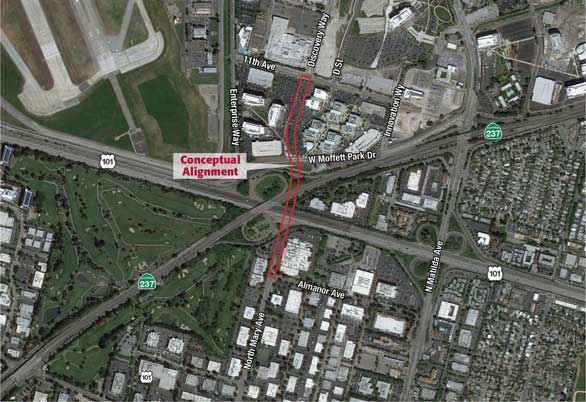
The city of Sunnyvale is studying a variety of options to connect Mary Avenue to the industrial / office area North of 101 and 237. The options range from a bicycle/pedestrian overcrossing to various alignments of multi-lane roads to support automobile traffic.

Mary-Ave-Overcrossing-Map

A second Community Meeting has been announced:

6:30 – 8:00 p.m. Tuesday, March 21, 2017
Columbia Neighborhood Center Multi-Use Room
785 Morse Avenue, Sunnyvale CA 94085

Project input is also solicited via Sunnyvale’s Open City Hall: https://www.peakdemocracy.com/portals/209/Issue_4652

KQED Discusses Caltrain’s Future: Friday Morning at 9:00AM

Residents interested in Caltrain may wish to turn in to KQED’s Forum program, 88.5FM, at 9:00AM Friday morning. From the KQED web site:

Episode airs February 24, 2017 at 9:00 AM
Arguing that the South Bay’s transportation system is breaking down, the urban planning think tank SPUR released an ambitious proposal for the region Thursday. In its Caltrain Corridor Vision Plan, SPUR proposes improvements to Highway 101 and calls for Caltrain to quintuple its ridership, expand service into downtown San Francisco and upgrade infrastructure. The SPUR report follows the Trump Administration’s decision last week to suspend $647 million in funds for Caltrain’s electrification, a move the rail agency says will hinder its ability to make needed improvements. We discuss the future of Caltrain.

The Caltrain Corridor Vision Plan (Spur.org)

Guests:
Ratna Amin, transportation policy director, SPUR
Randy Rentschler, director of legislation and public affairs, Metropolitan Transportation Commission
Seamus Murphy, chief communications officer, Caltrain

Caltrain Electrification Deferred

Background

Due to the success of our local economy, the peninsula’s rail link, Caltrain, has record ridership. Trains are often packed to capacity. The system’s ability to carry passengers is critical to economic growth and to mitigating road congestion.

Caltrain's booming ridership. Source: Wall Street Journal

Caltrain’s booming ridership. Source: Wall Street Journal

The system is overdue for upgrades that would improve its ability to cost-effectively carry passengers. Caltrain has been working to electrify the system since the 1990s. Electrification will allow Caltrain to run trains faster, more frequently, and at lower cost.

In September 2016, Caltrain signed contracts to carry out the electrification work. The contracts are contingent upon Caltrain funding the project by March 1, 2017. Without funding, construction will be postponed and the contracts will need to be renegotiated. Local, state, and regional funding is committed, but the Federal Transit Administration has informed Caltrain that federal funding is deferred until the President Trump’s Fiscal Year 2018 budget.

Current Status

Earlier this Month, California’s Republican delegation asked US Transportation Secretary Chao to deny the funding for Caltrain in hopes of blocking construction of High Speed Rail. The Federal Transit Administration has subsequently informed Caltrain that federal funding is deferred until the President Trump’s Fiscal Year 2018 budget.

Caltrain Modernization would create jobs Across the United States

Caltrain Modernization would create jobs Across the United States

Unless the United States Department of Transportation releases the federal portion of the funding by March 1, the electrification project will be delayed. 9,600 American jobs associated with this work will not be created. Local commuters will continue to pack into overcrowded trains, and our roads will see no relief for another half decade.

Call to Action

Actions you can take:

  1. Sign Caltrain’s White House Petition
  2. Send a Letter to Secretary Chao
  3. Call Secretary Chao and her career staffers:
    Elaine Chao (202) 366-4000
    Matthew Welbes (202) 366-4040
    Lana Hurdle (202) 366-6031
  4. Call Democratic lawmakers and thank them for their continued support:
    Anna Eshoo (650) 323-2984
    Zoe Lofgren (408) 271-8700
    Ro Khanna (408) 436-2720
    Kamala Harris (415) 355 – 9041
    Diane Feinstein (415) 393-0707
  5. If you have friends or family living in Republican-controlled areas of the state, explain this issue to them and ask them to contact their Congressional representative.
  6. Check out http://www.greencaltrain.com/2017/02/top-actions-to-save-caltrain-electrification/

Plan B?

Green Caltrain has a good review of what could happen if the funding does not come through. One prospect is to proceed with the project, but use slower electric locomotives instead of optimal “Electrical Multiple Unit” trains, which would limit the capacity increases otherwise possible through modernization. Our region could and should to follow the examples of Seattle and Los Angeles to pass a transit “megameasure” to fund our own infrastructure, but such an undertaking could not even begin until November 2018. Caltrain could perhaps be combined with BART, privatized, or underwritten by wealthy local tech companies.

UPDATE: Kim-Mai Cutler has published an excellent article on this topic with greater context and a wider call to action.

Saturday: Bake Sale for Planned Parenthood

Sunnyvale residents are hosting a Bake Sale this Saturday. Proceeds from the Bake Sale will be donated to Planned Parenthood. This Bake Sale is a local action inspired by the national “Defund Planned Parenthood” rally, taking place on February 11. Resident Manuel Luschas reports the bake sale is “definitely happening rain or shine, we’ll move into my garage if needed.”

When: Saturday, February 11th
Time: 10am to 3pm
Place: 567 Chiloquin Ct, Sunnyvale CA
Contact: laurareinitz@yahoo.com

From the organizers:

We are having a bake sale for women’s health at our home this Saturday. Please stop by and get yourself some delicious treats and coffee/tea!!

All are welcome! Gluten free and healthy options will be available. Stock up on snacks!

Take Action: Trump Administration Threatens Caltrain Electrification

California’s Republican delegation has submitted a letter to Federal Transportation Secretary Elaine Chao requesting that she cancel $647 million in funding for Caltrain electrification. The GOP delegation explains their intention to hold back the High Speed Rail project, but these specific improvements are badly needed by Caltrain to improve service for local riders. Bay Area representatives have followed up with their own letter to Secretary Chao explaining the need for this funding to be preserved. This issue is explained in detail on the Green Caltrain site.

Call to Action: Green Caltrain would like as many folks as possible to submit emails to Secretary Chao via this link: http://org.salsalabs.com/o/741/p/dia/action3/common/public/?action_KEY=21065

VTA Fare Review: Public Input

As part of the VTA’s Next Network project to change the transit system’s design to provide greater service frequency, VTA is reviewing fare policy. VTA invite you to contribute to a Public Input Survey. Surveys are due by February 20.

The survey is accessible here: https://www.surveymonkey.com/r/VTAFareReviewPublicInput

Also, Silicon Valley Transit Users have a nice summary of upcoming meetings for those who wish to learn more about and provide feedback to VTA about the Next Network.

Proposed AMD Site Redevelopment

Mercury News has announced a plan to convert the old AMD headquarters into over 1,000 units of housing.

“According to the project application submitted to the city, the plan for the 34-acre site at 1090 E. Duane Ave. is to build 136 units of for-sale housing, 651 mid-rise apartment units, 289 walk-up rental apartments and possibly a 6.5-acre park. Plans also include 1,954 parking spaces.”

Neighborhood Quality

Most of the surrounding neighborhood is already residential. There are several schools in the area, a Church, a Temple, a gym, Fry’s and Sports Basement. There are some restaurants across Lawrence and an Indian grocery across the street. Walk Score of 57 “somewhat walkable” seems accurate: you can access a number of neighborhood services without a car, but the neighborhood looks like it could use additional services.

The site sits at a transition between residential to the North and West, and retail / commercial to the South and East. Depending on what sort of amenities neighbors desire in their neighborhood, this might be a good opportunity to push for mixed-use development.

Traffic

Much of the traffic will likely go to 101 via Lawrence Expressway. There is a decent chance of housing workers in nearby office / light industrial and retail areas, which would reduce the traffic generated by this site.

Transit

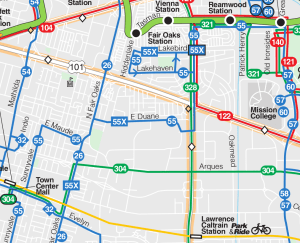
Current transit service is poor. The best service would appear to be the 55, providing infrequent service connections to Sunnyvale Caltrain and light rail.

The area is served by a couple of express buses which make a total of six trips per day per direction.

Lawrence Caltrain is just over one mile away, but it is an ugly walk down an expressway. Fair Oaks has an infrequent North-South bus service, a more pleasant one mile walk down Duane.

amd-vta-curr

Current VTA service.

vta-amd-next

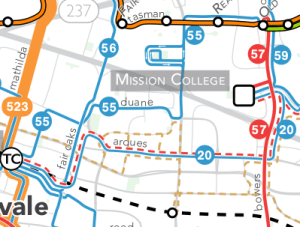
Next Network draft service

Under the Next Network Draft, transit service would improve somewhat, with the addition of Route 20, running from Sunnyvale Caltrain, along Arquez, over to Mission College and the new BART station. This bus connection to Mission College is valuable owing to a lack of pedestrian and bicycle access across 101 in this part of Sunnyvale. The 20 is proposed to run frequently during peak periods, infrequently mid-day.

Next Steps

This site will require a zoning change and is under a Specific Plan designation, so this development will be vetted by the Planning Commission and City Council. Neighbors will be notified of the plan and invited to provide public comment.

This is site is not yet on the agenda for any public hearings.

AMD Headquarters Featured Image Credit: Coolcaesar via Wikimedia Commons

VTA Publishes Draft for “Next Network”

The VTA Board has received a draft of the “Next Network” which is VTA’s plan to gear the transit network towards serving more riders. The overall strategy is to provide fewer, more direct routes with greater service frequency to make transit more useful to transit riders. Let’s start with route legend:
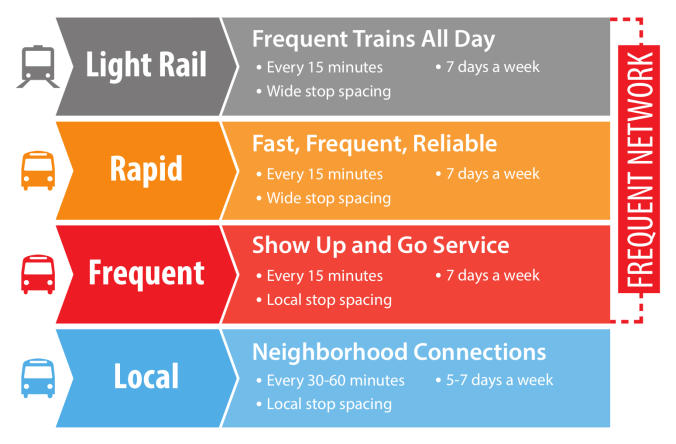
vta_next_network_draft_201701-legendI read this as:

  • Red means convenient transit service (every 15 minutes)
  • Orange means convenient and fast (15 minutes, limited stops)
  • Blue means there is a bus, but check the schedule …

Here’s the current system map (left) and the draft (right) for the Sunnyvale area:

Some of the changes slated for Sunnyvale:

El Camino Real

Decrease weekday frequency on Route 22; increase frequency on Route 522.

New Rapid Service

  • Route 523: North-South from Lockheed Martin via Mathilda / Sunnyvale-Saratoga to De Anza College, then East-West via Steven’s Creek to San Jose: Vallco, Valley Fair, Santana Row, BART.
  • Route 23: (Stevens Creek to De Anza) Decrease frequency from 12 to 15 minutes on Route 23; increase frequency on Route 523.

New “Neighborhood Connections”

  • Route 20: (Evelyn / Arques to BART) Create new Route 20 that would connect Milpitas BART Station, Mission College, Santa Clara Square, Downtown Sunnyvale and Downtown Mountain View. New Route 20 would provide service to areas currently served during commute periods by parts of Routes 58, 321 and 304.
  • Route 21: (Middlefield) Create new Route 21 that would connect Downtown Palo Alto with San Antonio Transit Center, Downtown Mountain View, Downtown Sunnyvale and Santa Clara Caltrain Station. New Route 21 would replace current Routes 32 and 35.
  • Route 56: (Wolfe / Fair Oaks) Create new Route 56, which would connect Lockheed Martin Transit Center to Downtown Sunnyvale, Vallco Mall, Downtown Campbell and Winchester Transit Center.

Modify/Remove “Neighborhood Connections”

  • Route 26: Split into two separate routes; replaced by Route 56 in Sunnyvale.
  • Route 32: Discontinue; replace with new Route 21.
  • Route 53: Change routing to serve Vallco Mall and Santa Clara Caltrain Station instead of West Valley College; this change replaces part of current Route 81. Increase frequency on weekdays.
  • Route 54: Discontinue Route 54; add more frequent new Rapid 523 service on Mathilda Avenue/De Anza Boulevard corridor.
  • Route 55: Change routing between Downtown Sunnyvale and Remington Avenue from Fair Oaks Avenue to Sunnyvale Avenue; decrease weekday peak period frequency and increase Sunday frequency.
  • Route 81: Discontinue; replace Moffet Field to De Anza College segment with new Route 51. Replace De Anza College to Santa Clara Caltrain Station segment with revised Route 53.

BART Connections
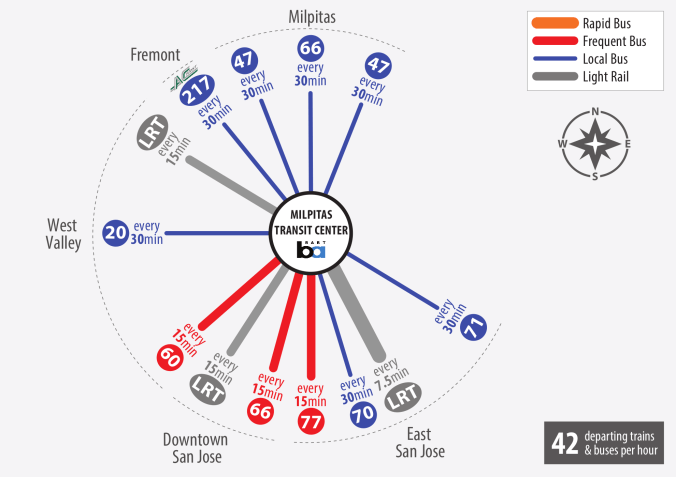
bart-201701

When the Milpitas BART Station opens and we get our new bus system, Sunnyvale will have some connection to BART:

  • The light rail system will be re-aligned so that Mountain View routes to Alum Rock / BART
  • Every 30 minutes, route 20 will meander from BART over to Mission College, Sunnyvale Caltrain, then continue down Evelyn to Mountain View Caltrain
  • Every 15 minutes, route 60 will connect to San Jose Airport and Santa Clara Caltrain before heading south to Campbell

Initial Reaction

These changes are a step in the right direction.

I like the frequent light rail connection to BART, and the 523 rapid service.

I would prefer more frequent service in Sunnyvale. (Change some of the blue to red.) Maybe prioritize frequency on lines that can extend the frequent light rail service to BART:

  • Route 21 West on Middlefield to Palo Alto
  • Route 56 South down Fair Oaks / Wolfe

With the addition of route 523, route 55 south of Sunnyvale Caltrain looks like duplicate service which might be better applied elsewhere.

I’m not sure if Route 20 is such a great BART connection. It might be that despite the transfer, light rail to route 523 would be more convenient to downtown Sunnyvale.

Sunnyvale and Santa Clara are working on a plan to bring in a lot of housing around Lawrence Caltrain station. This new transit-oriented community should have local transit service. It may be that the timeline for this development is such that it would be accommodated in a future round of VTA service adjustments.

Route 21: Middlefield

I really like the idea of a single bus route the length of Middlefield as far as Palo Alto. Running parallel to and more frequently than Caltrain along a well-known corridor, it could reproduce some of the success of the 22. I think it would be better if it continued straight along Middlefield between San Antonio and Moffett:

  • The route already provides Caltrain connections at Sunnyvale and Palo Alto
  • The detour duplicates Caltrain connections provided by route 44 and employer shuttles
  • A straight route would provide service to many apartments, offices, and retail along Middlefield
  • A straighter route provides faster service to passengers
  • A straighter route is more intuitive to customers
  • A simpler route reduces operation costs, making frequent service more feasible
  • Route 22 avoids detours to connect to Caltrain, and it is VTA’s most popular line

One potential vision for route 21 is as a frequent route that can extend the frequent service provided by light rail down through the offices and apartments in the North of Mountain View clear to downtown Palo Alto.

Get Involved!

VTA will be holding a series of meetings to gather community feedback. Here are a few that will be in the Sunnyvale area:

Cupertino
Wednesday, January 18 at 6pm
Quinlan Community Center, Cupertino Room
10185 N Stelling Rd Cupertino, CA 95014

Palo Alto
Thursday, January 19 at 6pm
Palo Alto City Hall, Council Chambers
250 Hamilton Ave Palo Alto, CA 94301

Campbell
Monday, January 23 at 6pm
Campbell Library, Community Room
77 Harrison Ave Campbell, CA 95008

Mountain View
Monday, February 6 at 6pm
Adobe Building
157 Moffett Blvd Mountain View, CA 94043

Public comments on the draft plan will be taken through February 20, 2017 and can be sent to community.outreach@vta.org.
Research: Low-Income Housing Doesn’t Depress Neighboring Home Values

Research via Trulia:

The bottom line for NIMBYs who fear that property values will take a hit when a low-income housing project locates nearby is that their anxiety is largely unfounded – at least in cities where housing is either expensive or in short supply.

The research looked at 20 of the nation’s least affordable housing markets, and compared changes in home value in neighborhoods where low-income housing was built, relative to neighboring areas which did not add low-income housing.

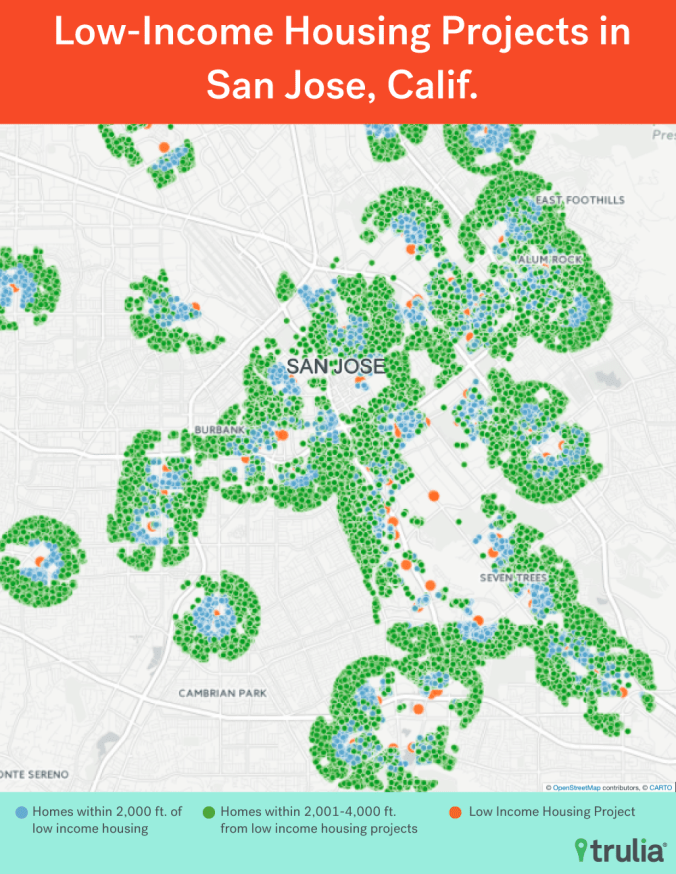
Homes within 2,000 and 4,000 feet of low-income housing developments in San Jose, Ca. Source: Trulia

Homes within 2,000 and 4,000 feet of low-income housing developments in San Jose, Ca.
Source: Trulia

Such statistics may be useful to reference when evaluating proposals to add Low Income Housing.