On November 18, the VTA Board of Directors directed staff to begin designing a new transit network which will provide a greater emphasis on ridership over coverage. This is a critical step in the VTA Next Network project which has been in process throughout 2016 and will culminate in a new bus / light rail network in 2017.
Improved Service Frequency
This represents a big step forward for VTA, which has lagged behind comparable transit agencies for more than a decade. The goal is to encourage people to ride transit by making transit services for most people more convenient. This is to be achieved by a network of bus routes which run at least every 15 minutes. Prospective passengers can simply walk to a bus stop with an assurance that they will soon get a ride, without the hassle of planning their trips around timetables. The tradeoff is that in order to provide more frequent service on heavily used lines, overall network coverage in areas with lower ridership will be pared back or removed altogether. In Next Network terms, VTA is moving from a current orientation of 70% service, 30% coverage to a network of 85% service, 15% coverage.
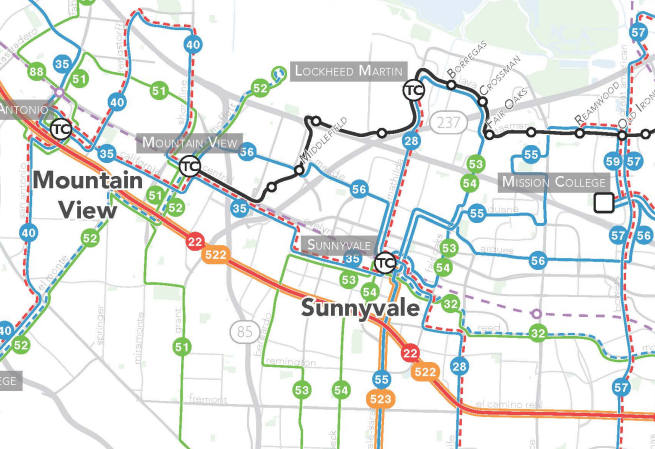
 Concept: 70% Ridership, 30% Coverage |
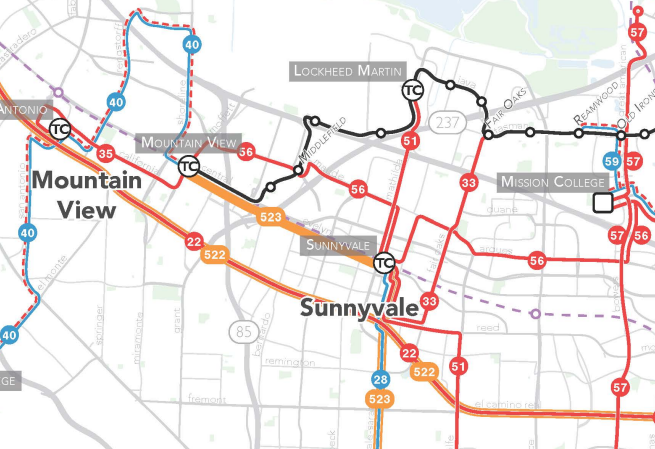
 Concept: 90% Ridership, 10% Coverage |
The above are “concept networks” from the VTA Next Network site. The left is “70% ridership” which means more coverage with infrequent lines, while the right is “90% ridership.” The color key is:
- Thick Orange — Extra Frequent Rapid: limited stops and 7.5 minute peak frequency
- Red — Frequent: 15 minutes or better
- Blue — every half hour
- Green — hourly service
With the board directing VTA to pursue 85% ridership, one can expect a sparser map with more red lines.
Mobility Concerns
Green Caltrain’s Adina Levin summarized community and board concerns over how to provide mobility to those who might lose transit coverage:
Cutting coverage harms people whose service is cut, especially youth, seniors, disabled, and very low-income people who don’t have other transportation choices. According to federal law, transit agencies have a legal obligation to provide paratransit service only on routes serviced by fixed-route bus service. If the bus route goes away, so does the paratransit service.
At the meeting, several community members from Palo Alto came and raised concerns about the 88 route. Penny Ellson of Palo Alto commented that the route serves a number of schools, and was a key factor in the decision to locate senior housing.
To alleviate impacts on disabled people, VTA staff recommended potentially keeping paratransit routes even where buses no longer ran. And in response to concerns raised by communities that would lose low-ridership routes, staff recommended options including block grants to cities to run local shuttle service, and experimentation with transportation network services such as Lyft and Uber, which might be able to provide access at a lower per-ride cost than fixed route buses, and using excess paratransit capacity for on-demand service.
The Lyft/Uber option sounded compelling to board members including San Jose Mayor Sam Liccardo and Council Member Johnny Khamis. Board chair Supervisor Cindy Chavez expressed concern about potentially undermining public transit. The future economic viability of services like Lyft and Uber is also questionable.
Improving Connections
A critical factor in the success of a frequent-service network, is the ability to connect between bus routes and between the bus system and other transit services. Green Caltrain noted that this was also a concern of the VTA board:
Board members including Sunnyvale Mayor Hendricks and Santa Clara Vice-Mayor O’Neill strongly supported the recommendation to reduce the cost of transfers, including transfers to BART and Caltrain. A board member suggested that rail agencies with higher farebox recovery provide VTA with financial compensation for providing feeder service.
See Also
VTA Board of Directors Meeting Details
Next Steps
- December 8, 2016: VTA Board of Directors Meeting–Agenda will be posted to VTA’s website 72-hours prior.
- January 5, 2017: VTA Board of Directors Meeting–Draft transit plan will be presented to the Board.
- January – February 2017: Public Outreach Period–Draft transit plan will be released for public review and input.
- April 2017: VTA Board of Directors will adopt a final plan
- Fall 2017: BART extension and VTA Next Network begin operations
 Greater Sunnyvale